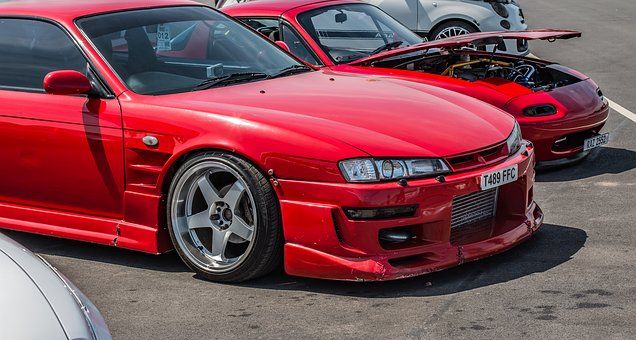
These Low-Cost JDM Cars Are Nothing But Trouble
Although some of these JDM Cars are a pain to work on, others are so underpowered that they are not enjoyable to drive.
Japanese automobiles have a near-perfect reputation for being dependable, inexpensive, and powerful. After all, they have engines that last hundreds of thousands of miles and produce decent power with limited displacement. The Honda Civic was regarded as the most reliable car ever made in the mid-1990s, and this trend has continued with Hondas and Toyotas to this day. Unfortunately, not every Japanese car is a winner.
Some are a pain to work on or are so underpowered that they're no fun at all. Others work on borrowed time, which disappears as quickly as sand in an hourglass. In any case, there are a few JDM cars that deserve a ten-foot pole.
Subaru SVX (Suzuki SVX)
Subaru launched the SVX, a two-door coupe with a 3.3-liter H6 engine that developed 230 horsepower for the 1991 model year. The SVX had all-wheel drive and just a four-speed automatic transmission, which was a travesty in and of itself.
Around 80,000 miles, the transmission begins to slip, presumably due to overheating, according to owners. Two of the radiator tanks are made of thermoplastic, which melts when exposed to heat and leaks coolant. Furthermore, after 60,000 miles, the carrier bearings inside the rear differential wear out.
GSX/GST Mitsubishi Eclipse
The 4G63T, a 2.0-liter inline-four with 210 horsepower, was used in the second-generation Mitsubishi Eclipse GSX and GSTs. Power was sent to all four wheels on GSXs, but only the front wheels on GSTs. On their own, the naturally aspirated Eclipse engines were dependable enough, but the 4G63T has a reputation for being unreliable.
In all fairness, the 4G63bad T's rep stems from owners who use a lot of boost without properly maintaining the engine, which, according to owners, is a time-consuming operation. However, since finding a completely stock GSX or GST is virtually impossible now, moving some boost past stock is probably not a good idea.
RX7 FB (Mazda RX7)
The Wankel rotary engine is probably one of the most popular (or infamous) features of the Mazda RX-7. It's a four-stroke engine with a rotating triangular rotor that completes each cycle instead of pistons. Wankel rotary engines are brilliant by design.
They have fewer components, are smaller and lighter than piston engines, can rev higher, and are internally balanced, allowing for smooth power delivery. Unfortunately, the Wankel rotary engine has a range of disadvantages, including low fuel efficiency and a high oil consumption rate. They must be inspected and maintained regularly.
X90 Suzuki
Suzuki produced the X90, a sport compact SUV with a 1.6-liter inline-four engine, for two years. The X90 will reach 60 mph in 13.3 seconds thanks to its 96 horsepower and all-wheel-drive system. Airbags and brakes were listed as major safety issues by owners.
The airbags in the X90 failed to deploy in many head-on crashes at 55 mph. This was a common problem during both years of development. Additionally, owners reported issues with the X90's ABS, which caused the car to lock its tires under hard braking, causing it to skid into an accident.
Nissan 300zx Z32
The Nissan Z32 was the company's follow-up to the 300zx, a tall, powerful, and elegant wedge-shaped sports car powered by a 3.0-liter V6 engine. The Z32 produces 220 or 300 horsepower with its turbos sent to the rear wheels through a limited-slip differential. Nissan managed to integrate two turbochargers in the engine bay for the TT model.
In terms of available elbow space, the engine is a nightmare to operate on. Depending on the year, cylinder head valves may be defective, brake rotors may be bent, and alternators have been known to fail after 50,000 miles.
Mitsubishi GTO is a sports car manufactured by Mitsubishi.
The Mitsubishi GTO, also known as the 3000GT in North America, was another large, heavy sports car from the 1990s. This was a wedge-shaped sports car with 220 horsepower without turbos and 320 horsepower with turbos. A 3.0-liter V6 powered the front wheels of the SL model, which lacked turbos, while the turbocharged VR4 powered all four wheels.
Owners have recorded oil leaks from the transfer case and delayed shifts with the automatic transmission. While good condition 3000GT VR4s is challenging to come by at a reasonable price, non-turbo variants can be found for an affordable price.
Mazda 626, 1993-1997
The Mazda 626 was one of Mazda's most divisive vehicles in the mid-to-late 1990s. The 626 was available with a 2.5-liter V6 engine that delivered 165 horsepower to the front wheels, though some versions were available with four-wheel drive.
These cars are praised in the forums when fitted with manual transmissions, but it's best to avoid if it's infected with an automatic transmission. Some of the 626s were equipped with Ford automatic transmissions that lacked the transmission coolers intended in the original design.
Suzuki Samurai is a Japanese swordsman.
Suzuki's Samurai, a small but tough four-wheel-drive SUV, was another example of mid-90s auto industry dysfunction. In 1995, Samurais were equipped with 1.3-liter inline-four engines that produced 66 horsepower. Although they have a devoted following, Samurais are afflicted with their illnesses.
The Samurai was prone to rolling over due to its short wheelbase, resulting in a slew of alarming noises from the transmission and exhaust. Because of its short wheelbase, the Samurai was prone to rolling over, resulting in a slew of unsettling noises from the transmission and exhaust. A burned fusible link could kill the battery, and the Samurai was notorious for rolling over quickly due to its short wheelbase, resulting in a slew of disturbing noises from the transmission and exhaust. They aren't really untrustworthy, but there are a few things to keep in mind.